27 October 2004

Don't mess with this piece of real estate


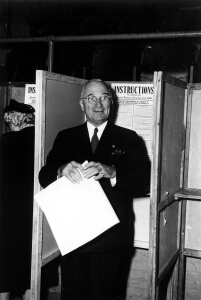
Truman leaves a voting booth
the day of the 1948 elections. Posted by Hello

Once a government is committed to the principle of silencing the voice of opposition, it has only one way to go, and that is down the path of increasingly repressive measures, until it becomes a source of terror to all its citizens and creates a country where everyone lives in fear.
--Harry S Truman, August 8, 1950

The 33rd President of the United States also said that the voting booth is the most valuable piece of real estate in the nation, and that if it is sold then likely the nation will cease to exist.

It is unfortunate that underhanded events have happened in several of the nation's campaigns over time. Even if it yielded a win for the perpetrators, the behavior of an administration during a term would demonstrate whether they would win a subsequent election.

For most parts of the nation this has been the safety net, because the citizens and politicians have given the voting booth, the polling place and the a ballot box a near sacred status.

Throughout history candidates have simply encouraged people to vote, even without telling followers to vote specifically for them, knowing that the secret ballot with one vote per person has been the single most important right of a US citizen. In many ways it is what defines a US citizen as different from being a member of any other country.

During the 2000 national elections questions arose over which candidate won. As it turned out, even the side that won admits that the number of popular votes went to the opposition. But from the supreme court, wherein no one in the majority decision would put their name to a majority opinion, came a faceless decision in a 5 to 4 vote. (The dissenters, however had no fear of writing an opinion.)

While we have questioned the Electoral College many times as the process for deciding presidential elections during the past couple centuries, in 2000 we accepted the results of the vote as a matter of faith. This faith was held with the assumption and assumed knowledge that in four years we'd have another chance to cast our ballots.

We knew that in four years, as in every other election cycle, that if there were problems or if there was an opportunity to change the management of this nation for the better, we the electorate would be able to cast our ballots as we always have and know that the wisdom of a majority would be respected as each ballot would be given equal weight, equal importance and respected as a revered right.

In this nation we don't tamper with the US Mail, because it is a "Federal Offence" an important common knowledge that is a combination of mutual respect and security. Similarly, there is not a preponderance of counterfeiting of currency - even though today's design and printing technology would make attempts much easier.

So it has been with voting and the ballot box. Neighbors have respected each other when they knew a difference in political leanings, and if they wished to keep that difference confidential it was another form of mutual respect maintained by the voting booth and the secret ballot.

As this country has grown, history has corrected election improprieties in various regions. In most areas they serve as reminders that systems in this democracy work.

Following the flame of principle established by the nation's founding documents state, "...all men are created equal," the Voting Rights Act of 1965 with its subsequent revisions recognized that the last single descriptor of being a citizen -- the thing that makes one whole, to make all citizens whole -- was the unalienable right to vote without being impeded and with no differentiating qualification.

It was as if to say, "even if we can't help everyone's economic plight, even if we can't correct all social injustice, even if opportunities are not always equal, the single most important thing we can do is assure the right to vote to all, and protect that right by making the result of the plebiscite elective self expression so important that it is untouchable, and to do otherwise unthinkable."

I see in the near future a crisis approaching that unnerves me and causes me to tremble for the safety of my country. . . . Corporations have been enthroned, an era of corruption in high places will follow, and the money-power of the country will endeavor to prolong its reign by working upon the prejudices of the people until the wealth is aggregated in a few hands and the Republic is destroyed
------Abraham Lincoln


With days remaining before the next election, verified reports are emerging of tampering with voter registrations, ballots, the disposition of absentee ballots and challenging individual electors using or manufacturing false information about them.

THIS IS NOT A PARTISAN RANT! These are actions that should be abhorred equally by both sides, for the devaluation of one vote diminishes the rights of all, and threatens subsequent elections. While it is becoming apparent that one side is perpetrating these acts against fellow citizens, one would think the questions that arose over the last election would have current leaders being extra diligent at avoiding even the appearance of impropriety.

With current actions showing a blatant disregard for the rights of fellow American citizens, the basic principles of logic confirm the likelihood that the discrepancies in question during the last election were purposely executed. Now we have come to believe that all find the act of voting, and the handling of ballots as near sacred, while those who don't are taking advantage and manipulating the outcome.

Here are some examples:

- With voting underway in Florida, eyes turn that way as a list of felons developed to disallow voters was not being released. During the 2000 election, a similar list was developed and included thousands of names of people who had no prison or police record, preventing those named on the list from their right to vote.


Click: The Herald Tribune


- A campaign headquarters document in Florida outlines a plan to disrupt voting in certain districts.

Click: BBC News: Florida vote scandal feared


- Not all concerns are taking place in the south. In an effort to limit the number of newly registered voters from actually casting ballots, Milwaukee County official refused to print the estimated 260,000 ballots requested by city officials.

Milwaukee Journal Sentinel

- This initial glitch was resolved after the Mayor, the Governor and the attorney general joined the debate, and Milwaukee County will now print the extra ballots required.

Milwaukee Journal Sentinel

The latest hassle facing voters in the area include absentee ballots which come with a stamped self addressed envelope. But by accident one of the remote voters had the post office check to see if there was enough postage. Most voters will assume that the 37 cent stamp supplied is adequate to get their vote to their home polls. After checking, it turns out the return ballot need additional postage to bring the amount up to 60 cents for the USPS to deliver the ballot to where they can be counted.

-Journal Sentinel - Wrong postage is latest absentee ballot concern

- In Nevada, an organization promoted registration of voters, but subsequently discarded all the registrations affiliated with one of the parties keeping people who thought they had registered from being allowed to vote.

Constitution Center

- Back to Florida, where today, 58,000 absentee ballots were misplaced in transit to Tallahassee

Local Channel 10

- And Ohio has started with a variety of voter concerns, perpetuated by officials who are to serve all of the electorate.

Columbus Free Press

- Along with blatant devaluation of ballots, redistricting and simple but purposed changing of voting locations, votes are being accepted and denied randomly along with provisional ballots that allow people to be pacified but confused until the judiciary in one sweep destroys all pertinent ballots (as they have done in several areas) rendering thousands of ballots invalid, and sweeping away the common thread that makes all of those individuals citizens.

AP - The wrong polling place

And there are more being reported daily.

Although these reports deal predominantly with the workings of one political party over another, voters in both parties should be concerned. The parties ostensibly could be reversed, but it appears that the 2000 election behavior was just a rehearsal for more nefarious dealings by the current administration's party election worker's in 2004.

But everyone, no matter what their affiliation should be infuriated by those who would use a single ill-gotten vote to their advantage, let alone hundreds of thousands.

With friends in both political parties, I know no one who in good conscience would condone such behavior. Members of both parties whom I know believe in decency and a sense of fair play. They know and believe that even if they disagree with the opposition's plans that their vote is just as important as everyone else's, and respect an honestly represented true majority. They also know that after an interval of time they will have the opportunity again to cast votes in a scenario that celebrates the differences, debate, discourse and trusts

They understand that the ballot box and the voting booth is one of the freedoms that people through our nation's history have fought, sacrificed and died for, insuring that this little experiment in self government succeeds to be enhanced by the next generation.

Until recently we looked with some condescension on other countries that required independent international observers in order to insure a fair election. When watching reports about those countries, we thought of ourselves as being beyond that with systems that worked and a society that was civil and conducted fair elections. But now it would be as if we were looking in a mirror.

Best to all,

Lloyd
.

15 October 2004

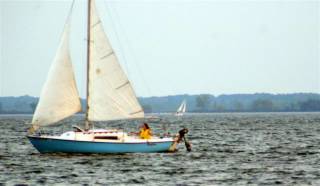
When a student learns it can be like...sailing


File photo: Lloyd Posted by Hello

There have been many opportunities to act as a teacher over the years. As a music/theatre major I later took on private students who were studying/playing 'cello and a few voice students. While several were a bit of a struggle - and the struggle was theirs - many were successes and they were kind enough to share their success; a source of great thrill for most teachers making up for the energies expended on the struggles.

Most recently I had the opportunity to be a teacher in an interesting environment. The story below could be called "What I did on my Summer Vacation." But it is more about how everyone gains when skills and knowledge are shared.

The majority of the summer of 2004 was filled with one of two activities.

First, I have to say that I was in the weird position of having to take vacation from my regular work in order to finish contract work on a couple of specific projects. Read that again: I had to take vacation time in order to get my work done. A situation that could have have been depressing if it weren't for my other distraction, sailing.

Saying farewell to sailing early in my marriage was an easy tradeoff considering the number of things my sweetheart has put up with over the past three decades. But the urge to harness the wind and slide across the water returned in earnest a few years ago.

It all came down to the fact that my wife was not a water person, and instead of it being a source of sporting stimulation, water activities were a source of terror. Of course, if I'd known that, I'd likely have made her first sailing experience all those years back, a little less exciting.

A series of guilt-laden ploys over a period of time a few years back finally yielded the "thumbs up" on acquiring a sailing vessel, and returning to the life on water that I had left when Gerald Ford was president.

Not wanting to push the issue, I pursued a clunky looking boat that looked safe with an appearance that likely put its designer to sleep. Shortly after starting the hunt, I came home from a Chicago area marina with a 22 foot South Coast cruiser that had been pulled out of its slip in Lake Michigan. It fit the formula perfectly, a clunky looking sloop on which everything was present and intact, with a hull color that screamed 1971 as if the Brady Bunch itself was expected to swim across her bow. With the vessel a study in irony, it seemed only appropriate to Christen her "Pinafore" after the Gilbert and Sullivan comic operetta featuring a ship of the same name with a crew whose exploits should never be taken seriously.

In an effort to be concise I take license to time-travel to early spring 2004 when the stars aligned and a good friend made some contacts so Pinafore could be parked in Rock Lake near Lake Mills, affording me the opportunity to hit the water and hoist the sails within ten minutes after leaving my home.

But another opportunity presented itself with the boat's close proximity. My wife, one of my children (at first) and two of my friends showed a special interest in learning to sail, giving me the delightful challenge and opportunity of teaching them how to safely sail, show them some of the nuances and introduce those four to the enticements of sail. A built-in plus included the odds that shortly I'd have a crew member at any given time to help out when winds became brisk and efforts to 'single hand' Pinafore required that I be in more than one place on the boat simultaneously.

Just like students learning a new musical instrument, talents developed at varying speeds.

But one of the crew trainees displayed a particular enthusiasm, and became a part of the Pinafore crew almost by accident. On our way back from a shoot, a person whom I often hire to assist with freelance commercial photo work was with me at the end of the day when I mentioned that the boat was tied off not far from the route home. She insisted that she wanted to see the old cruiser. It never takes much arm twisting to get me to talk sailing.

I kept playing down the dated watercraft, but even after seeing the 'retro' cruiser she continued to ask substantial questions about the old boat and things nautical in general. Enthusiasm at this level is hard to surpress, so I offered to take the boat out and motor about for a short excursion.

Well we didn't even hoist the sails that trip and the good questions kept coming, so much so that I finally said, "Here, you take the helm," explaining that as the term for position of the person who steers the vessel - also giving her something to do before I ran out of answers. I mentioned that I would be training members as crew and that she (for the purposes of this blog she'll be known as CR as she often is in real life) was invited to join the group. I noted that the group was going to meet a in a few days and that she should plan on coming out, but I also mentioned that it wasn't just a matter of going out, setting sails and catching 'rays.' It was a matter of learning many safety aspects to protect the boat and other crew, it was a matter of learning terminology, rules, regulations, history, theory. It was also a matter of learning about the weather, learning the characteristics of this specific water craft. And finally a matter of having all the mechanical factors of harnessing the wind and getting the craft where you wanted to go become a natural series of readings and reactions.

While we planned to meet as a group a few days later, CR called the next day and said she had a conflict. Thinking that her apparent enthusiasm had waned, I said that she was certainly not obligated in any way. But she stopped me short and asked if the boat would be going out anytime before the group was to meet. Well, of course it was - that afterall is why I had the boat in water so close to home.

So we met the next day after I made the return trip from Chicago, having met with a client in the morning. Like air filling sails, sailing itself always gives me a second wind of energy. We spent some time at the pier where I explained the difference between standing rigging and running rigging. We talked over which lines did what, what needed to be accomplished while getting under way and generally what made a sailing craft...go.

As a little quiz, I asked if she could remember some of the specific parts of the boat. She did, and continued on impressively and correctly with more terms after I finished the little quiz. CR was like a horse at the starting gate, and I recognized that it was time as a teacher to get out of this student's way.

We motored out beyond keel depth, and as I was getting ready to hobble up on deck to hoist the sails she passed me up and asked if she could yank the halyards to raise the two expanses of Dacron (the canvas of today). I sat back down at the tiller and said, "hoist away." A brisk day gusting to 15 knots I stayed at the helm, but pointed out all of the factors to consider at every point of sail, giving assurance that cruisers this size with 700 to 1000 pounds of steel or lead in its keel are extremely difficult to capsize, even though the wind made the Pinafore heel over to near 20 degrees during the course of the session. While 20 degrees isn't much off of perpendicular, with racing yachts spending a brisk day at 30+/- degrees to the point where skipper and crew are basically leaning on the deck while standing on its edge, even 20 degrees can seem like more when a green sailor is along and the skipper seems to be daring Mother Nature to incline your craft much more.

After about two hours, I turned the boat in toward our pier to the dismay of the new student. Again CR volunteered to douse the sails. After explaining the procedure she litely jumped to the top of the cabin trunk as if she had a set of natural sea legs, where my hiking on deck in brisk weather has been characterized as more of a "lumbering" action. I turned Pinafore upwind and both the jib and mainsail began to luff. As the boat bit into the oncoming chops, CR cut loose the jib halyard and stood solidly on the foredeck as she gathered up the foresail. Returning to the mast she set the main halyard loose, I let go of the tiller and began to to flake and lash the mainsail. CR started lashing it from the other end. "Are you sure you haven't been sailing before?" I asked. She assured me that her life until then was one of a full blown land lubber.

The summer continued with planned trips including the group and various sub-sets, but regularly CR would have arranged her own schedule to get some extra time under sail. She remained enthusiastic, but it seemed that with everything she absorbed in the learning process, she also gained a greater respect for the sport. After several trips out as a crew member it became obvious that it was time for her to act as skipper and take the helm, and let me be the crew, telling me what adjustments out of her reach need to be made.

Suggesting it was a good time for her to take the tiller and take the boat through its paces with me as the crew, CR hesitated. She paused, and said she really should just continue as a crew member. With that, under full sail, I stood up and headed to the cabin, hinting that someone should take the tiller (at that time CR didn't know that sails sheeted tightly will generally pull the vessel around into the weather, bring the boat to a stop and drop the air out of the sail to the point where they'll simply flap around). She veritably dove for the tiller and brought Pinafore back on course, frantically asking what I was thinking. To which I answered "I think it is time you took the helm."

Again it is an exciting moment when a teacher gets the opportunity to get out of a student's way, and it was clear that this student was ready to move on faster than the rest of the crew trainees.

CR stiffly took the boat through several maneuvers and points of sail, before I suggested we head in.

After that CR would take the helm regularly under varying sorts of weather, learning to adjust to get the optimum set on the sails. At first it was a matter of adjusting after conditions changed blatantly, but the adjustment to any settings were always correct. Many sailors never get beyond this point.

Just as every student who is learning a new language works at it until "things just click," sailing fell into place for CR.

The difference between inland sailing and off shore ocean sailing is the quality and consistency of the wind. Most often in blue water sailing, the wind stays the same, is rarely gusty and usually changes at a pace that allows sailors to adjust as the changes are happening. I like to call off-shore mariners set-and-forget sailors. Inland wind is subject to more change due to winds coming off of land formations, a range of varying other factors and generally one accepts that there will be gusts, even at points 30 miles off-shore on Lake Michigan.

One day we were out after CR had become quite used to the routine and was familiar with almost all activities on the boat. So much so that I began to wonder if learning had hit a plateau, or if I had any more to offer this student.

The weather that day called for 7 to 10 knot winds, but predicted mid afternoon an increase of winds that would be 10 to 15 knots. On a comfortable set of tacks against a southwest wind we were heading across the narrowest point of the lake, an area notorious for providing conditions almost opposite the day's prevailing winds. I went into the cabin to grab binoculars, then stood up in the companion way, which allowed me to lean on the cabin roof and keep my head under the boom.

Going from a port tack to a starboard tack, I aimlessly looked through the glass. More than a mile away, on a cloudless day I could see that the water was turning dark, and the ink-like hue was advancing to our location rapidly. Immediately I knew that the dark shade was riffling on the current waves, taking away their glimmer and that the predicted wind change was coming across with a substantial introductory gust. I looked back at CR who was studying the set in the sails, and then bit my lip in an effort to not be too directive and continue to let the learning experiences happen. I did, however, work at being nonchalant and started ever so slightly to lean windward.

I took one more glance over my right shoulder, then let it go, looking toward the bow. About ten seconds later the wind picked up whistling through the shrouds. I prepared to jump through the hatch and cut loose a jib sheet, but knew that the old cruiser could heel beyond 90 degrees before thinking about capsizing, so I decided the best thing a teacher could do was nothing but wait.

Bracing myself as the wind hit, I felt Pinafore nudge slightly, but then settle into an increased speed. I relaxed as the boat locked into a comfortable beat, and we sailed on to the south end of the lake.

After we came about I stepped back out into the cockpit and sat on the weather side. After sitting and simply enjoying the sail for another ten minutes, I looked back at CR and said "Uh, did you notice the wind pick up before you came about?" She replied with a glib "Uh-huh."

I mentioned that we didn't really heel over too much. She replied, "Well I just flattened the main, and headed up wind a bit, then reclaimed the course as I let out the main sheet."

" And you did it well," I replied.

It occurred to me then that, like one who is learning a new language, things had 'clicked' for this student. I also realized that the role of a teacher is always changing. Sometimes it is a matter of literally spelling out every action, and sometimes it is just a matter of turning on a light so a student can see the path. The most difficult thing is recognizing which degree of need, so that a student is neither overwhelmed nor held back when ready to move on. But when a student finds success and feels accomplishiment, as a teacher I feel the thrill of a skydiver.

The training provided to new crew has been like a rank system that yacht trainers use on their way to a level of maritime certification. The next step for CR was to 'single hand' or solo sail, and she absolutely had the skills. However, like the first time she took the helm, I had to practically trick her into the solo sail. Every time I mentioned that it would be a good day for a solo run, she decided that her schedule was full, though I could hear that she wanted to be on the water under sail.

One day, I suggested we go out, and with the wind level up we'd likely have to 'reef' in the main (bring in some sail to have a smaller surface area), and I would need a decent crew to go out. After heading out I came around and brought the Pinafore in to a public pier. We were on approach before she asked why. Grabbing a cleat on the pier and stepping off the gun'l I threw a camera around my neck and turned back to tell her why... "...so you can solo."

She grabbed the pier and protested. "Lloyd, I'm not ready for this!"

I gently said that I thought she was.

"No, I'm really not. Now come on back. I'm not ready to solo."

Her hand slipped from the pier for a moment, and I took advantage of it by shoving Pinafore off. "Prove to me that you're not ready!," I said adding that it was near sunset and the weather was changing.

Shortly, the old cruiser was more than its own length beyond the pier. CR gave me a resigned look and asked what the assigned route was. I told her to head out on a certain heading south, bring it to the east on a broad reach go to within a safe distance of the east shoreline and come about to tack out the same distance to the south, then cut back west -southwest beating close to the wind then head west across the point of the pier, continue on then jybe north back to a point even with the pier and bring it on in.

I saw waypoints click in her head as if I were a choreographer dishing out steps to a dancer. She yanked the starter on the long shaft outboard, snapped it into reverse, pulled the stern around, changed gears again and headed out. It was the first time I had been this directive with this student.

The list of tasks to remember can be exceptional: After motoring out, killing the motor, lifting the motor, CR winches down the keel (a 700 lb five foot fin of steel on 2 tons of boat) , she hoists the sails, goes through the route making all the correct adjustments, then douses the sails, lashes the main, winches up the keel and motors back. She also made a correct decision in leaving the main reefed (note the main is almost the same size as the working jib), then she qeued up in a holding pattern with a boat that unexpectedly arrived to be hauled out. Then she brought Pinafore back to the pier.

She was elated and I was proud as punch. She also admitted that she was stalling about doing the solo over a period of weeks.

We were losing daylight, so shutter speeds on my camera were slow making it hard to hold steady, but if you click on the picture below, you will see CR on her solo sail. Clicking on the picture, you will be taken to another page. Click that new picture and you will see a 20 second compressed slide show of the 25 minute solo sail. Realize that it symbolizes a student success, a demonstration of determination to take on something completely new and the culmination of an effort to acquire new skills, pounding the individual skills into a complete talent.


Solo sail for a former land lubber - click here then click on pic
at that site.
Posted by Hello

While acting as the teacher in this situation, as usual I'm sure I am the one who learned and gained the most.

Best to all,

Lloyd

14 October 2004

Block Schedule: Will it crumble?

 
This blog spends a lot of it's time on school matters.  This happens for many reasons including the fact that there is a lot going on within the district, a learning environment is an exciting and interesting environment, and the energy of youth is generally contagious.
There are so many good things that can and do happen in public schools that one can feel the need to give change a little scrutiny, yet one of the exciting things that occur in schools IS change.  But change can be an exciting trial for the future, and often times change takes a fork in the road under the guise of advancement which is in reality a step backward.
This blog has already gone on record commenting on returning to the use of bells to signal class changes, and sees it as a step backwards.  There has since been another blog (see "Echoing bells") citing information about schools that don't use bells between classes, just as a reference point.  It isn't as impassioned as the original bell blog "Hells, Bells".
But this time our interest lies with what may have enabled Johnson Creek schools to dispense with bells in the first place - block scheduling.  That alone is a good reason to use block scheduling, a system set up to have fewer longer classes (typically four) per day and have the same classes daily for at least a semester.
On the upside of block scheduling, longer projects can be completed in science classes, shop classes, math classes... lets face it in all subject areas.  Generally schools appear more relaxed, classes are closer to the length of classes in post-secondary institutions AND they likely counter the short attention span fostered years earlier by the likes of Sesame Street.
Education World has a tendency to agree with the latter.  They say

  • When students attend as many as eight relatively short classes in different subjects every day, instruction can become fragmented; longer class periods give students more time to think and engage in active learning.
  • A schedule with one relatively short period after another can create a hectic, assembly-line environment;
  • A schedule that releases hundreds or thousands of adolescents into hallways six, seven, or eight times each school day for four or five minutes of noise and chaotic movement can exacerbate discipline problems.
  • Teachers benefit from more useable instructional time each day because less time is lost with beginning and ending classes.
  • I give block scheduling several 'charm factors' for providing an environment conducive to learning AND teaching,  but there are admittedly times when charm factors aren't worth the paper they're written on, just as many educational mandates make requirements in programs without taking into consideration funding or practicality, or space, or equipment, or...!?!
    During the course of a four year experience in high school, students still attend sequentially difficult classes in a variety of subject matter.  With block scheduling, it is possible that a freshman taking an advanced math class requiring a prerequisite may take the prerequisite one fall semester, but due to a schedule only allowing four class periods per day over a semester,  the advance math class may not be available until that student's junior year.  A similar scenario can play out in foreign language classes, with an introductory class one semester, but the school or the student schedule not allowing high level coursework in that language until more than a year later - making it potentially difficult to retain information from the first class.
    It is difficult for humans and computers alike to schedule students satisfactorily under these situations.
    The initial reaction is to return to the eight period day, which is in effect suggesting that block scheduling was just a fad, and that may be the case.  However, it is up to administrators and boards to determine what characteristics in curriculum development are more important, a solid learning environment conducive to learning or a schedule and curriculum tantamount to a checklist so that we can report, "yep, we touched on this subject, this subject, this subject and this subject..." without a chance to savor or go into depth at any one point.
    How many of us grown-up type people actually do eight different things in a day?  All of us are busy, and while I am writing and doing research  for this blog and have written two other articles on separate subjects today, it often comes down to listening, reading, taking notes and writing.  Different topics, but the same work.  Yes, I may run to the grocery store, and have the tires rotated on my car, but adding those two things to the one thing I do ends up sounding like an incredibly busy day.
    I think the "out-of-school" equivalent of an eight period day could go something like:
    1. Go to work where you bake muffins and plan a menu before your boss has you
    2.Go to your church or synagogue and translate a few pages of scripture from original languages prior to
    3.Running to a lumber yard to finish blueprints that you picked up from the building inspector after proving geometrically that the structure is sound according to the codes and principles of engineering which needed to be done before you.
    4. Write a legal brief using historical context with proven research sources and then it is time when the company requires the arts so you
    5 Haul your instrument to the local chamber music society to practice with an ensemble for the inter-corporate competition, after which you play
    6 Play a mandatory game of dodgeball to test a new product - but your job description says it's your day to
    7. Collect water samples from bodies of water to check for contaminants and record that day's weather observations, but before that you are expected at the company conference room to
    8 Solve some advanced algebraic equations just because they are there, and everybody else does. 
    At that point you just can't wait to go home and zone out mindlessly in front of the television...
    Granted most of us grew up with an eight hour set of classes, but one begins to wonder if the increased incidence of ADD/ADHD is not induced when requiring some to approach new concepts and consider the meaning of a Shakespeare play during a portion of one hour, then switch to plotting solutions to problems in multidimensional differential Calculus (which isn't related to anything tangible) during a portion of the next hour.
    It is a tough choice, because schools are charged with providing so many hours of core curricular classes in a sequentially advancing curriculum.  BUT there is nothing in Wisconsin State Laws that say students MUST learn anything.  It requires an amount of school time to be offered or attended and curricular areas to be approached.  Individual districts decide on what constitutes a credit, and how many credits are required to graduate.  (Current standardized basic knowledge tests aren't intended to test students, but to evaluate schools and attach that to public funding, BUT that is a subject for another blog.)
    So it isn't a clear choice, block scheduling offers many optimum learning situations.  One wonders if absolute sequential courses could be offered ONLY in paired up schedules e.g. "If you take Greek I first semester YOU WILL take Greek II second semester." essentially making it a one year class.
    The eight period day allows for a schedule where one can say 'we met the spec and touched on everything required.'
    In an effort to find materials on both sides of the issue, it appears that there are a variety of issues involving many variables.   Read through the research and you will find favorable and unfavorable findings.  One reason for this lies with the fact that not all block schedules are the same. Several studies in individual schools in Iowa say that grades decreased with block scheduling along with ACT and SAT scores, while Minnesota and Wisconsin finds the opposite to be true.
    If local indicators are that it works, then it would behoove administrators and officials to stay with it using education as the primary rationale.  If grades and any other school characteristic are declining then it may be time to consider something else.  But it may not be an all or nothing situation. 
    Then it is time to simply find what works,and do what works and not lock into an inflexible model that will prevent the best education for everyone. 
    1.  What characteristics are positive about block scheduling according to teachers, students, administrators and statistics and studies? 
    2.  What characteristics of the traditional schedule are positive or beneficial according to teachers, students, administrators, studies and statistics? 
    Find the commonalities and expand on those commonalities to fit the needs of the students and the district.

    27 September 2004

    Echoing bells

    At the risk of a repeated topic becoming annoying like the tintinnabulation of bells between classes, you are encouraged to read on with additional, possibly interesting information regarding bells in schools. If you haven't read the first blog on this topic, click here:

    http://fieldtrips.blogspot.com/2004/09/hells-bells-sometimes-less-really-is.html

    The first blog discussed the addition of bells between classes at Johnson Creek's upper school took about 15 minutes to write and questioned the value of bells in today's educational setting. It also suggested that the previous lack of bells was a non-monetary asset, a characterisitic to which many of the nation's leading schools aspire. Ironically, many reviews say that it is one of the characteristics that schools will want to replicate.

    Since then a minor amount of additional research has yielded more information, if only to see how the matter fits in context. As it turns out it is usually a factor or a descriptor that people use to tell, write or brag about their school. It is a situation which adds to a school's percieved and educational value.

    In the last bell blog one school was used as an example of what many schools are aspiring to. It referred to New Tech High School near Napa, California, using their lack of class change signals as an initial bragging point.

    Find more about that school here:

    http://www.scholastic.com/administrator/novdec03/articles.asp?article=spotlightschool

    A School Design Planning site called Learning By Design again has the assumption that school can exist without class change signals, especially in the small school environment.

    In an essay entitled Smaller, Saner Schools it talks about
    "...
    a rural school board (that) agreed to authorize what has become one of the nation's most noted secondary schools: Minnesota New Country School (MNCS). This secondary charter school enrolls about 125 students in grades seven through 12. It is run as a co-op, with faculty members "owning" the school, setting their own salaries and working conditions.

    Each school year starts with a family/student/advisor conference. The conferences help students develop a plan for how they will make progress toward graduation, which is based entirely on demonstration of skill and knowledge.

    There are no grades or bells. Each student has a workstation with a computer. Students work individually or in small groups on projects that help them achieve the required mastery. Teachers see themselves as facilitators and coaches, moving from student to student throughout the day. Every six weeks the school has a presentation night, during which students share information they've learned. Each student makes a presentation at least three times per year. The presentations often include computer graphics and PowerPoint. Students have become so sophisticated that some of them have been hired by local businesses to create Web sites."


    This site can be found here: http://www.asbj.com/lbd/2002/inprint/smaller.html

    In another article, Kathleen Cushman writes:

    It's all too easy to bury oneself in the details of the schedule and forget the kids themselves. If we think hard about how they learn best, we must confront some uncomfortable truths. The clock does not direct or control learning, nor do the artificial cycles of terms and tests and report cards. In fact, sometimes those things-all integral to the very idea of a school schedule-often interrupt and impede the way kids learn.

    "The simpler a high school schedule is, the better," asserts Ted Sizer. "Just because it's so complex, it must be solved as a matter between particular teachers and particular kids. Why not create a few long blocks, then keep all decisions about the 'bells and whistles' as close to the kids as possible? If I'm teaching history and some students need to go to band, I would just keeping on doing something special in class with the kids who don't go."

    To create such conditions, schools might have to undergo a fundamental attitude shift. A learner's individual needs would matter more than the orderly processing of groups. The emotional investment of students in their work would matter more than what time they start and stop it, or where they carried it out. We would think of learning as continuous and connected, not delineated by bells, course boundaries, or exam dates. And everyone in a school community would be doing it all the time.


    By the way, this site touches on many educational issues about scheduling. Read it here:
    http://www.essentialschools.org/cs/resources/view/ces_res/15


    In St. Louis' Carr Lane Middle School is known as the 'school without bells' and it's mission statement describes the school "...where students are viewed as valued present and future citizens of a global society."

    It's unfortunate that we take for granted one of several characteristics that the Bill and Melinda Gates Foundation (yes, that Bill Gates) is pushing for in funding the establishment of new small schools. They began the initiative after studies indicate that large urban schools, and schools which have a higher enrollment as a result of excessive consolidation, have higher dropout rates and that there is a direct link to poverty and a lack of achievement as a high school enrollment becomes excessive. But it isn't the school population alone which has this impact - it is the infrastructure and the non-educational aspects that can have a negative effect on education.

    In the web site "Students Learning in Small Schools" a report indicates that many of these new schools are pushing to have what already exists in many Wisconsin rural schools, or is readily available without any cash outlay. It says:

    More than personalization and the absence of bells

    What first catches the eye when one enters a small school is the personalization it affords. Both the needs of individual students and the passions of individual teachers seem to find uncustomary breathing room. A first-time visitor might also be struck by what appears to be less structure than larger high schools employ: students and adults may mix more freely; no bells may mark the start and end of classes; courses may break from curricular conventions or may not even exist at all. Repeat visitors learn that in most small schools a complex infrastructure actually puts order in these freedoms.

    This site has fascinating information about findings regarding the assets of small schools. Read more about it here:

    http://www.whatkidscando.org/portfoliosmallschools/portfoliohome.html


    Alright, you are already at your computer reading this blog so all you have to do is click on the links provided to read about one characteristic of what the leading schools are including to enhance the educational environment (or print it out and take it with you to read later). Additionally, there is information there on many of the other characterisitics of these schools, many of which Johnson Creek already has in place. But are they at risk, too?

    Just as education never ends, neither does homework. If nothing else, read the info, and just be aware of factors that can have an impact on education. It's exciting to see what is happening as these new schools develop - it's just as exciting as the educational efforts put forth locally. Let us do nothing to limit those local efforts.

    Best to all,

    Lloyd
    27SEP04


    21 September 2004

    Why Lloyd doesn't cover sports

    Often, when sauntering amongst the communities that make up my news beats, people ask why I don’t do sports.

    Of course at that point they have answered their own question – I don’t do sports. Report on it, that is.


    First and most importantly in becoming a sports reporter one must know something – specifically the game.

    Actually, I have done a fair amount of sports photography, but in my oft dual capacity of being a pictures and words guy, I am seriously lacking in sports words.


    The reason I don’t know the games, or haven’t taken the time to learn are unknown. I must qualify this, too. What I have never learned are the chief games that hit the front pages of local papers. So if it’s football, baseball, tennis, volleyball, softball, basketball and a myriad of other mainstream sports, one at times would do just as well to put teams of dancing zombies on the field or floor and strap to my head a loudspeaker connected to the Chicago Transit Authority for 90 minutes for the sense I make of it.


    Yet I find things interesting when I do attend, and those things are the ones I would center my sports news article on.

    To illustrate this I have written a mock sports story on a fictitious game between the Marshall High School Cardinals and the Lake Mills L-Cats - two non fictitious teams.
    The names I use will indeed be fictitious, but any names that do exist on either of these two teams will be complete and utter coincidence. Here goes:

    LAKE MILLS – With a cool faint breeze coming out of the north, the Marshall Cardinals flew in to touch down on the grid-iron of the Lake Mills L-Cats. The question looming over the field was whether the L-Cats would devour those red birds from western Dane County.

    Having done research with those whom are evidently not fans of the Marshall team, it was originally thought that the school colors – red and white – were symbolic of our patriotic history with red standing for blood and white for bandages. Still another apparent non-Cardinal fan suggested that the name was based on a layer of the hierarchy of the Roman Catholic Church. While this suggestion was summarily dismissed, the nagging fact remained that Nashotah Seminary’s team is the known as the Black Monks.

    Two and two quickly became four as their logo with the crested red bird of the north made it safely evident that they weren’t a group of young ornithologists – in addition to the logos, there simply was not a pair of binoculars in the bunch.

    From the other side of the field the Lake Mills L-Cats crawled ready to pounce. After previous research on this team, the origins of their mascot name dating from WW II is well known. The reigning question about their name: Why do they keep it?

    Really. Even they must be tiring of explaining what an L-Cat is. And half of them don’t know, making up such rubbish as “it’s a polite way to say ‘Hell-Cat,’” or “it stands for the L of Lake Mills.” Come on. Then they’d be called the LM-Cats, wouldn’t they? Even during the depression budgetary constraints didn’t get bad enough that letters had to be cut from team mascot names.

    So the rival between these two moderate sized school teams - scientific names Cardinalis cardinalis v. Felis "L" catus -began as the Cardinals’ red and white set out to clash with the L-Cats’ blue and gold.

    And what a clash – just the sight of red, white, blue and gold together on that field of green was enough to make an interior decorator nauseous.

    At that point conjecture sets in as to the advantage of each teams color scheme on the psyche of the opposing team.

    Apparently overpaid, and wanting to flaunt it, an official pulled a silver dollar out of his pocket and offered a coin toss to determine who would be kicking off.

    Without first inspecting the coin, the captains of each team yelled out their preferred coin face as it was in mid-air. Lake Mills won the toss and elected to kick.

    The kicker’s impact sent the oblong ball, euphemistically called ‘the pigskin’ deep into Marshall’s half of the field.

    As if pre-determined Marshall’s Einer Tingvold caught the ball and dropped to one knee as if incapacitated, leading one to believe more than ever before that the two battling teams should very seriously reconsider their uniform color schemes.

    But it turned out that Tingvold was okay, and there was evidently no animosity over his fake injury.

    After the initial play both teams went into a huddle. It is never entirely possible to understand what is discussed in the huddle. One of the last bastions of closed meetings in public, despite the fact we live in a Democracy and that the rule applies even in teams of institutions like public schools and universities, it continues to be overlooked by legislators and members of the country’s free press.

    Returning from the huddle it was apparent that the young players used the time to make decisions without letting the general public in on the outcome. But it was equally unknown to each team and the spectators, providing some sort of equity to the huddle situation.

    Lake Mills lined up flanking the ball as center John Behling leaned into to the oblong orb and QB Oscar Stanke moved in to a rather colloquial position behind Behling - a refreshing departure from the all to large effort to remain politically correct in public behavior.

    Barking out what is evidently his locker combination, Behling apparently became annoyed with Stanke, snapping the ball into Stanke’s hands. Stanke moved back but was shortly bowled over by the Card’s junior Orin Sorenson.

    Moving ahead less than a couple yards, Lake Mills tried this again, with Behling equally annoyed by Stanke spewing another locker combination. Again Sorenson moved in to take down Stanke.

    Evidence of a grudge-match ensued as the scene repeated itself, demonstrating Stanke’s uncanny ability to memorize locker combinations.

    With unimaginative choreography taking place under the lights on the field, another bit of sports related news seemed to be developing over at the concession stand.

    It seems that the local boosters had introduced an entirely new menu. While including the usual popcorn and bagged savory snacks, along with a variety of soft drinks, this year they offered pizza, hot dogs, brats and natchos.

    A surplus in the booster budget evidently allowed for the purchase of a couple small pizza ovens.


    The menu indicated that the offerings included pepperoni, sausage and a vegetarian pizza. However concessions director and parent Marian Tomlinson said to this point in the season the vegetarian pizza was a rare sale, leading her to believe that the menu would be geared entirely toward the carnivores in the crowd next season.

    Even though this crowd made it hard to discuss the matter with bouts of yelling, cheers and jeers overpowering customer orders at the food stand, Mrs. Tomlinson was able to point out a little recipe secret with the natcho sauce.

    Letting the “L-Cat” out of the bag, she noted that the usual #10 can of commercial natcho sauce was the base, but then she pointed out that the special zing in the sauce’s flavor was due to the addition of whole capers and several drops of Tobasco sauce, “…just enough to warm up the cool fall air,” Tomlinson said.

    Of course, along with the regular fare, there are home baked desserts, that booster members bring to donate to the concession stand.

    The mother of new student and football team member Bobby Behrends, Mrs. Becky Behrends, introduced a new flavor to the mix.

    While Rice Crispy bars are a perennial favorite, Behrends tried to explain the simple but tasteful ingredient, at first difficult to understand as the fans kept coming to their feet and howling at the field.

    But with perseverance, the secret ingredient was revealed as a touch of pumpkin pie spice, giving the old standby treat an added dimension.

    "It's okay I suppose, if you like that sort of thing," Mrs. Tomlinson said of Behrends' treat, indicating it may be an acquired taste for some.

    Kudos and bravos continued to go to the deserving concessionaires as these new items along with the former snacks sold consitently, albeit difficult for anyone to give or take orders with all of the noise near the field.

    Fortunately it all came to a crescendo right near the end, followed by a welcomed silence on a crisp autumn evening as the stands emptied, the stadium lights extinguished, leaving only the echoes of athletic exuberance and the faint smell of popcorn and bratwurst in the air.

    (Editor’s note: The final score of last Friday’s game: Lake Mills 24, Marshall 26 sending the Cardinals to the state finals.)

    Alright, that may be a bit of an exaggeration. It has been my honor to cover a variety of events over the years.The news bug bit me while living on the island of Guam. Prior to that I had been a music major with an emphasis on opera - needless to say there were limited operatic opportunities on Guam or the Commonwealth of the Mariannas, leaving me with the choice of pursuing a career in music elsewhere for a period of two or more years, or staying with my high school sweetheart and wife (who has at this point put up with me for 31 years) who was at the time assigned to Andersen AFB, Guam as a member of the USAF.

    It was my intent to be a photojournalist, which is what I tell people I am to this day. But during every editorial relationship someone has found out that I can write a complete sentence, roping me into the additional role of reporter/writer. It has allowed me to cover happenings in the Pacific, and over the past 20 plus years I have covered communities and individuals at their best and coversely, sometimes tragically, at their worst.

    After returning to Wisconsin, touching on agricultural journalism seemed to go hand in hand with the decade we owned a farm and started a family.


    The journey continues with mainstream magazine and newspaper work making every assignment an adventure. The nature of this journey doesn’t allow me to always report happy news or to share pleasant photographs. But it has allowed me to share facts about fascinating individuals and events with untold numbers of readers.


    It can be difficult when we, my colleagues and I, must report unpopular truths. But having lived places where the press is not independent of the current rule, it becomes obvious that it is much easier to deliver unpopular truths and have readers feel they can trust the source, than to modify information and toss every ounce of that commodity of credibility and public trust out the window.


    And if we are wrong, we want to hear about it. I’m merely a journalist, and the newspaper work I do is usually related to events or people in the area's small communities. But community news is “where it’s at” precisely because of this.

    If Sam Donaldson gets something wrong in his large market reporting, the only person he’s accountable to is his producer or the person who signs his paycheck. If my colleagues and I need to clarify something, there is a great likelihood that we will see the subject of our stories in the near future in the same or only slightly different venue, providing an accountability directly to the readership.

    “The Media” is and are something too broad to make general statements about, but it is important to remember that ‘freedom of the press’ is not a freedom set aside for those in the forth estate. It is a freedom set aside for everyone, with journalists and publications only the tools to help you enjoy that right. If you don’t insist on it, it could disappear.

    It goes without saying that freedom of the press, when it comes to sports reporting, is generally better off if I stay in the realm of general news and the variety it offers. If I had leaned that way, it would probably have been in the style of the late Howard Cosell, but even he would likely have missed out on the secret ingredient in the Rice Crispy bars.

    Best to all,
    Lloyd
    # # #
    21SEP04 LS

    02 September 2004

    Hells, Bells
    ---Sometimes less really is more...
    (Commentary/Editorial)

    Today was the first day of the 2004-05 school year. The time when teachers and students gather for the first time since departing on the unknown adventures that summer would hold.

    The last moments before the first class are a time of anticipation and excitement triggered by the smell of freshly waxed floors, newly painted areas and the aroma of the ink wafting from new textbooks, almost as if the information and ideas within had vapors of their own making the air heady with ideas for potential treks of the new learning experiences that lay ahead.


    But that special time of anticipation before launching into a new year was shattered at the Johnson Creek upper school by an annoyance, a new bell system signaling the beginning of classes. After asking about it, hoping that it was some sort of mistake, it was most dissappointing to hear that a noise had been implemented to signal class times.

    If I haven't written about it, I know that I have talked about an unquantifiable yet very tangible characteristic of institutions like Johnson Creek Schools, one I call the "Charm Factor."

    The charm factors at Johnson Creek Schools include the fact that grades K through 12 are on the same campus, which has promoted the use of upper class mentors and student aides at the lower grade levels. It has minimized class rank issues and streamlined the students' vision in understanding the route through the grades.

    Johnson Creek school charm factors include situations held unique where a student can be a successful athlete, musician, thespian and maintain an interest in agrarian roots by belonging to and being successful in FFA.

    Another is a built in support system, where everyone knows everyone in the school, with an enrollment of fewer than 600. That support system includes parents knowing parents and students knowing all the district families and realizing that a lapse in behavior will be addressed by all levels of peers and families in addition to school staff. This has kept the need for pre-emptive excessive rule making to a minimum. It is also the type of built in support system that held the school together a few years ago when a student perished in an auto accident, where in a larger institution the loss may have gone unnoticed by the majority.

    And of course the small student to teacher ratio is what education experts dream of and dream for getting closer to the goal of individualized education (although with ongoing budget constraints this becomes more difficult to maintain as the old solution of consolidating schools becomes more like herding cattle to go through the motions of providing an education...).

    Last year I remained silent as "security cameras" were installed in the hallways of the upper school. Reports indicate they did catch perpetrators of ongoing vandalism, as they record images from those hallways for days at a time. However one wonders if the cameras have
    deterred any acts vandalism or misbehavior. I sighed at their installation as they had the potential to undermine the charm factors that reinforce what the school stands for. But one also wonders how many events may have occurred in an attempt to outsmart the intrusive cameras, easily construed as a general vote of no confidence.

    Today, disappointment killed the excitement of the first day of school when the evidence of the school schedule bell system became apparent, knocking the legs out from under the charm the school once held.

    Across the nation, new schools are striving for characteristics like the ability to have class changes with no bells. The Scholastic Administrator website-

    http://www.scholastic.com/administrator/novdec03/articles.asp?article=spotlightschool

    -describes a new school in the Napa Valley, California as having "an open school culture" and a "celebrated model for replication."

    The first part of a description of the New California school says it is,

    "...AN OASIS OF LEARNING
    Walk through the doors of New Tech High's low-key building and you'll find a welcoming environment. With no bells to signal transitions between class periods, the hallways are peaceful and unhurried."

    And they are replicating what we used to have. These are characteristics leading schools are striving to have, and we are letting those characteristics dwindle.
    Flexibility has been a key to the success of the Johnson Creek school district. In every instance where one has compared the local schools to a larger district, I have been able to counter with a plus directly related to the intimacy and adaptability of the district.

    The class size coupled with a block schedule, allowing four 90 minute classes during a day with time for lunch and co-hort or homeroom activities, while having some bugs has the advantages first of being a relaxed atmosphere more conducive to learning. It allows for entire cooking projects to be completed, impromptu field trips to collect samples for science classes, time for lecture and lab work and precious time for rehearsals. There are some shorter classes creating a modified block schedule, but as a whole as reported in previous school board meetings, grades have gone up and the number of people on honor roll have increased while using this system. It has allowed students to concentrate on four areas of study at a time instead of the typical eight in a fragmented schedule of bits and pieces.

    Up to this time, everyone has presumed that students and teachers could tell time. And when it was time for classes to change, students changed classes BUT it was done after a teacher completed a thought or an assignment, or a group returned from an impromptu outside lecture or fieldtrip.

    These are among the things we are teaching students to understand: When they get to college there are no bells, they must figure out how to be where and when on their continued journey through education and life or they miss out. There are no bells out there. Yes there are deadlines, the trains, planes and busses leave on a schedule, taxes are due April 15 and the curtain goes up after the overture. And some people miss out...

    Are the class bells an effort to have fewer tardiness reports? I hope not, because tardiness exists, has existed and will exist everywhere in this nation's schools. It isn't something that can be stopped with bells. Go to any school and it will be a concern of a few people, but an accepted fact by most educators. This is not to say that chronic tardiness is acceptable in schools if for the only fact that it disrupts classes and staggers the momentum of all of the students.

    One of the chief factors, a charm factor if you will, that I used to brag about regarding Johnson Creek Schools was that there WERE NO BELLS signaling class changes. It was as though they were making the effort to raise the students' level up to accepting and understanding schedules, leading by example instead of forcing through a mold. In fact I used tell people that the only thing resembling a bell or signal, when it worked, was a large grandfather clock in one of the upper school hallways.

    Now we have another vote of no confidence tossed at students, students who are becoming more sophisticated every year.

    Why must we head for the lowest common denominator? Sure all area schools may have bells. But hasn't Johnson Creek maintained a standard that says we don't need them? The ongoing the assumption that the majority of students will do the right thing at the right time is the reason tour companies, transportation firms and hotels have written to the schools regularly to compliment the school and the students for their exceptional behavior compared to student groups from other schools when on trips and performing tours.

    It is dismaying that the importance of students' timeliness has begun to supersede what they do after they arrive, because only a fraction of learning happens within the set time frame of the classroom. Students follow good teachers out on their own time to test the thermo-dynamics of shelters they built as part of a science project. They make the extra effort to attend rehearsals of musicals nightly, taking the energy of pros as teachers provide examples, often not realizing where the time has gone. They work between classes to gather resources for international humanitarian efforts. Students clammor to see Shakespeare performed in a setting realistic to the Bard's lifetime. They represent the young people of potential career choices who take part in competitions across the state and nation with the extra time and guidance from teachers. It is continued proof that school is and should be a verb - not just a place, or a building where one goes for a specific period of time.

    The class bells will have a limiting effect, and have already diminished what remains of the district charm factors. They are the factors in a school system that can make people invest in a home and relocate a family -as our family did. It could have an impact in the future growth of the schools as other families make decisions on moving...or maybe not.

    Once a gem is covered or lost no one knows it was there.


    There are times when people familiar with what exists don't recognize the glowing and positive facets as assets until they are gone, and that is a shame.


    -Lloyd Schultz
    2SEP04

    28 March 2004

    Nine characteristics of a good school board


    Buckminster Fuller once stated that human beings are the one species that could disappear tomorrow without causing a negative impact on the planet or its future. In micro-community terms, one might say the same thing about school boards and their impact on schools.

    Mark Twain put it a bit more tersely tongue in cheek when he wrote, and undoubtedly said, "In the first place, God made idiots. That was for practice. Then he made school boards."

    (At this writing my wife is on a school board, so I'm sure she will convey to me the collective wrath of other school board members who read the comments above, however they illustrate that school boards have indeed been the source of community debate for some time.)


    Evidence points to the possibility that school boards have been a source of frustration for students, parents, teachers, administrators and other school board members since the idea came on the scene. They have certainly provided ink to news articles, commentary and letters to the editor columns over the time they have existed, as well.

    But it seems that even with the whims of the voting electorate there are school boards that tend to work in ensemble over periods of years. And even with hitches or bubbles in the flow of the individual tasks, they ultimately keep things on a big-picture course. It is not an easy thing to sit on a school board, and those who think it will be should not throw their hat into the ring when an election arrives.

    Media publish or report on school boards in several areas within a region. Even within that region, the effectiveness and general quality of board work and accomplishments can cover a broad spectrum. Yet there seem to be common characteristics among effective boards that are dynamic and harmoniously provide for a proper and equally effective learning environment for the schools in their community.

    School boards, even in relatively close proximity to each other, operate in a variety of styles. In covering them for the media there are plenty of opportunities to observe the many differing operational characteristics. Here are observations of some characteristics that good and effective school boards seem to have in common:

    Plans - The least number of hitches in school efforts amongst staff and administrators, and subsequently within the community itself, happen where school boards have established a strategic long-range plan for their district. The plans are not etched in stone but revisited frequently. They continue on even when school board personnel change.

    The board acts as one - This is NOT to say that every vote will be or should be unanimous. This IS to say that board decisions are of the board as a whole. Good school boards seldom have members whose individual motives and agendas come before the needs of the district as a whole.

    Primary purpose in word and action is 'education' - Good school boards use education as their prime rationale, and coincidentally appear to usually have a very efficient district. In districts where the price tag is always the primary decision making factor, the educational process AND district management is often inefficient.

    Thrive on change - Boards that anticipate, adapt, address and initiate genuinely new ideas seem to be less likely to be denial oriented organizations. They also encourage this manner of thinking in their faculty, staff and with hope the students. They are the boards who don't show fear when the government imposes new budgetary or other restrictions, but allow more creative input into providing a quality education.

    Open with information and intentions - Like many publicly elected bodies, school boards are holders of public trust. Ideas are exchanged in open forums, and members of good school boards are not afraid to cite sources. School boards who are regularly open in their day to day workings, will be seen and trusted as accountable when and if a controversy arises.

    Reflect the kind of school they have/wish to have - Good school boards are like good schools. They celebrate learning, encourage creativity and each other. To paraphrase a more important work - when others are asking 'why,' good school boards are asking 'why not?'

    Realize their place in the community and school - While asked to alot resources for school systems, the better school boards and board members do not see themselves as being bestowed with directorial powers to call the shots in a school district. Instead, the better, more secure boards and members tend to act as if they are being elevated to a deeper level of service to the community and school district.

    Rely on experts - Good school boards seek, listen thoughtfully to, heed and respect experts in their field. They respect the people they depend on as the professionals they have hired or sought out, and assume that the motives of the professionals or experts are as genuine as their own. They let the people they have hired on behalf of the school district as experts in their field do the work for which they were hired. School boards which do not treat as professional, the people they hired to be professionals, waste the energy of both the board and the professionals. Boards which presume the staff, faculty and administrators are professionals and treat all as such, tend to have more harmonious interactions, and are more credible when real concerns arise.

    DO THEIR HOMEWORK - Good school boards are made up of people who study. The work of the school board is not just one related to one meeting per month. Effective school boards are made up of members who take time to read and question materials from faculty and administrators, organizations and the media. When they are tasked with a specific committee or area of concern, the study should not stop. Members call experts at institutions of higher learning, stay aware of education trends reported in the media, and seek out training and development opportunities for themselves. Armed with the comfort of absolute preparation, good school boards are fearless in providing their districts with the resources required for excellence in education - they provide those resources, then stay out of the way. For under those circumstances true quality education is unstoppable.

    These characteristics are a compilation of much observation. Often school board quality is cyclical, but at the ends of the bell curve are those which are consistently dysfunctional, and at the other end those few which are consistently providing resources and encouragement to provide a quality institution of learning.

    CreekNews encourages and supports school boards that have or are working toward the above characteristics.
    (copyright 2004 Lloyd Schultz)
    # # #